Navigating BHA FDA Regulation Status in 2026: What Food Manufacturers Need to Know.
September 23, 2026
Author
A trusted global supplier of chemicals and ingredients. Leafchem connects international buyers with high-quality cosmetics, food additives, and plant extracts, driven by a commitment to customer satisfaction.
On February 10, 2026, the U.S. Food and Drug Administration (FDA) launched a comprehensive post-market re-assessment of butylated hydroxyanisole (BHA), a synthetic antioxidant that has protected the fats and oils in processed foods for nearly seven decades. For food manufacturers, the move signals that one of the industry's most established preservatives has entered a formal period of regulatory review — with potential consequences for formulations, labeling, and supply chains. Here is what the FDA has actually done in 2026, where BHA stands under U.S. law today, and the steps manufacturers should take now.
I. Understanding BHA: Chemistry, Function & Regulatory History
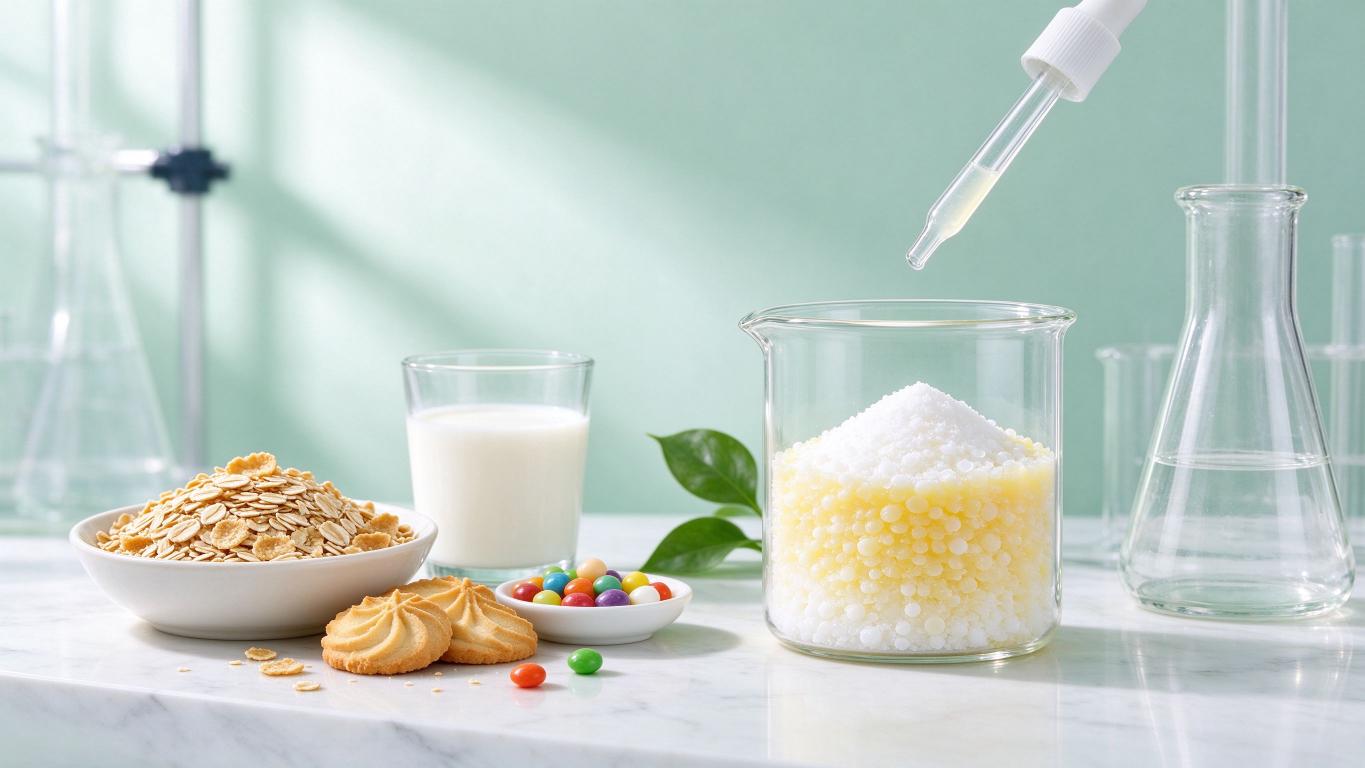
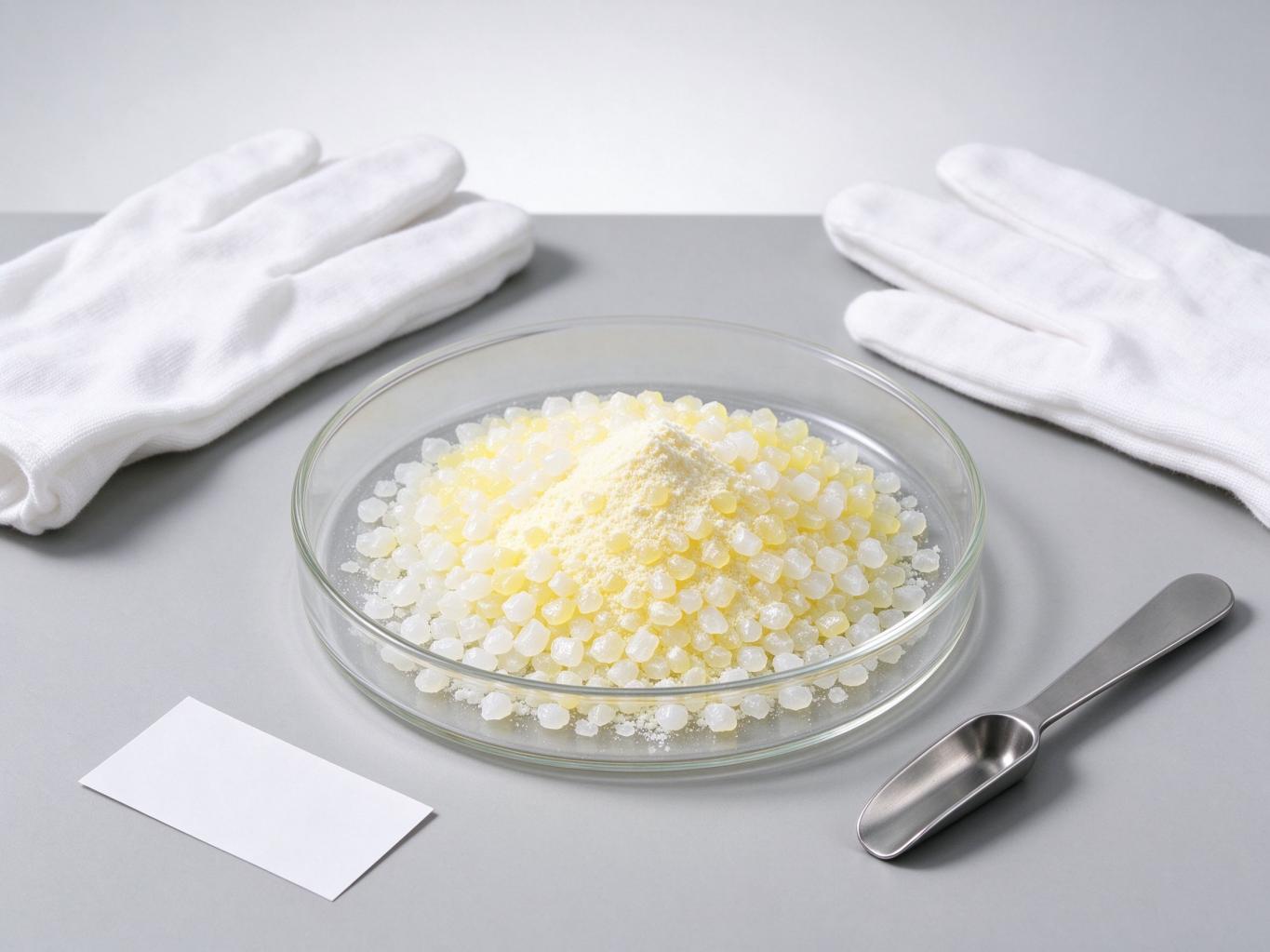
BHA (CAS No. 25013-16-5) is an oil-soluble synthetic antioxidant with the molecular formula C₁₁H₁₆O₂, typically supplied as a white to pale yellow waxy solid. Commercially, it is a mixture consisting predominantly of 3-tert-butyl-4-hydroxyanisole (3-BHA, CAS 121-00-6), with varying amounts of 2-tert-butyl-4-hydroxyanisole (2-BHA, CAS 88-32-4). Its function in food is to inhibit the oxidative rancidity of fats and oils, extending the shelf life of products such as frozen meals, breakfast cereals, cookies, candy, ice cream, and meat products.
Figure 2: High-purity BHA — a white to pale yellow waxy antioxidant solid
The FDA listed BHA as Generally Recognized as Safe (GRAS) in 1958 and approved it as a food additive in 1961. Today, BHA is authorized in the United States through several regulatory pathways:
GRAS antioxidant use (21 CFR 182.3169) — total antioxidant content may not exceed 0.02% of the fat or oil content of the food.
Direct food additive (21 CFR 172.110) — as an antioxidant, alone or in combination with butylated hydroxytoluene (BHT), in specified foods with listed limitations.
Flavoring substances (21 CFR 172.515(d)) — not to exceed 0.5% of the essential oil content of the flavoring substance.
Chewing gum base (21 CFR 172.615(a)) — total antioxidant content not to exceed 0.1% of the gum base.
Prior-sanctioned packaging use (21 CFR 181.24) — as an antioxidant migrating from food packaging, with a limit of addition to food of 0.005%.
Food contact materials — including coatings, adhesives, paper and paperboard, plastics, closures with sealing gaskets, EVA copolymers, machinery lubricants, and polyethylene film (e.g., 21 CFR 175.300, 176.170, 177.1350, 179.45).
USDA specifications — for butteroil (7 CFR 58.305(b)) and the standards of identity for margarine (9 CFR 319.700(b)(6); 21 CFR 166.110(b)(5)).
On the safety record, the NIH's National Toxicology Program (NTP) lists BHA as "reasonably anticipated to be a human carcinogen" based on animal studies; the International Agency for Research on Cancer (IARC) classifies it as Group 2B, "possibly carcinogenic to humans"; and BHA appears on California's Proposition 65 list of substances known to cause cancer. The FDA has stressed that its reassessment is being conducted on the latest state of the science.
II. The 2026 FDA Re-Assessment: A Timeline
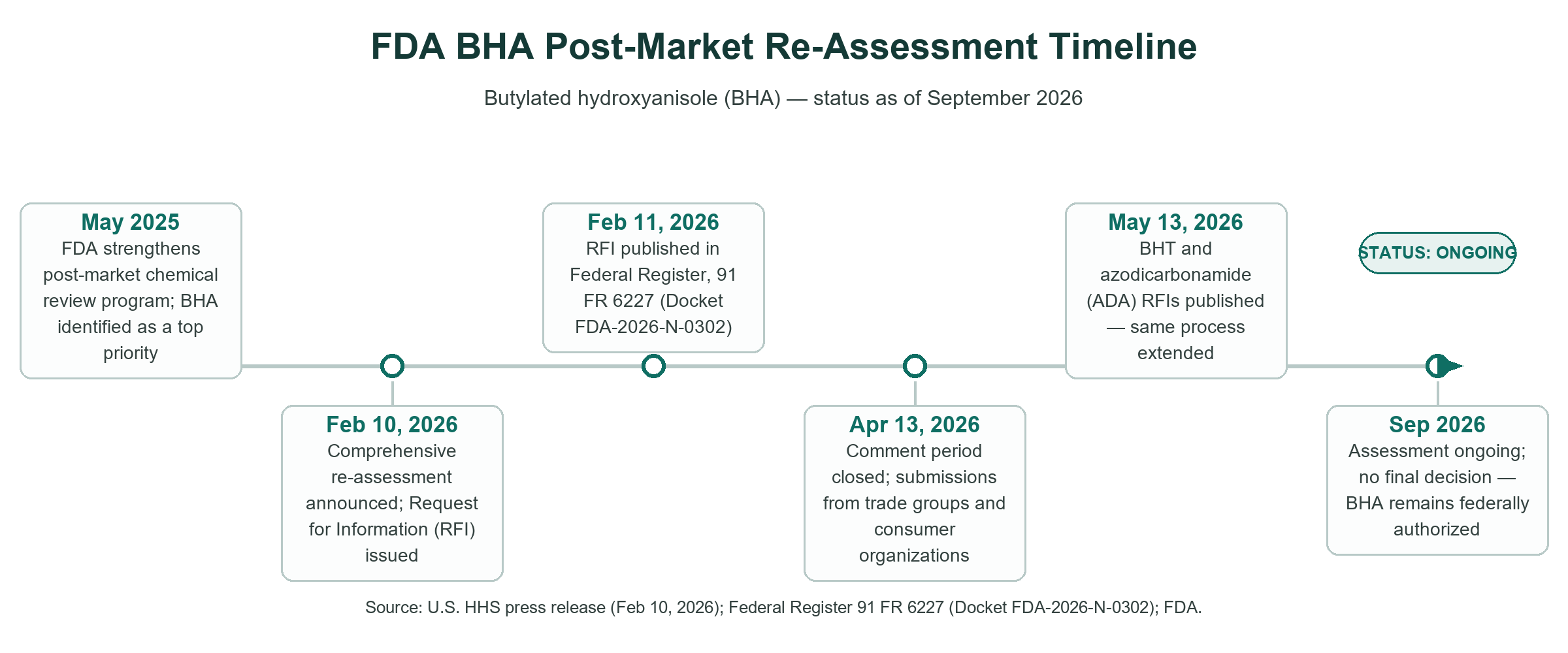
May 2025 — FDA launches a strengthened program to review chemicals already in the food supply and identifies BHA as a top priority for post-market review.
February 10, 2026 — FDA announces a comprehensive re-assessment of BHA and issues a Request for Information (RFI) on its use and safety in human food and as a food contact substance.
February 11, 2026 — The RFI is published in the Federal Register (91 FR 6227; Docket No. FDA-2026-N-0302), with comments due by April 13, 2026.
April 13, 2026 — The comment period closes. Submissions come from food and feed trade groups, flavor and chewing-gum industry associations (including the Flavor and Extract Manufacturers Association and the International Chewing Gum Association), and consumer advocacy organizations.
May 13, 2026 — The same process is extended to related synthetic preservatives: FDA publishes RFIs for butylated hydroxytoluene (BHT) and azodicarbonamide (ADA).
As of September 2026 — The BHA assessment remains ongoing. No final agency determination has been announced, and BHA remains authorized for its current uses at the federal level.
Figure 3: FDA BHA post-market re-assessment timeline, 2025–2026
Speaking at the announcement, Health and Human Services Secretary Robert F. Kennedy, Jr. stated: "If BHA cannot meet today's gold-standard science for its current uses, we will remove it from the food supply and continue cleaning up food chemicals—starting where children face the greatest exposure."
The reassessment implements the recommendations of the White House Make America Healthy Again (MAHA) Commission for an evidence-based, systematic post-market assessment process for chemicals in food. FDA has also stated its intention to propose a regulation that would close the "GRAS loophole," which currently allows manufacturers to conclude that a food chemical use is GRAS without notifying the agency.
III. What the FDA Is Asking Manufacturers: Inside the Request for Information
The RFI requests data across a dozen categories, including:
1. General food categories in which BHA is used, with typical and maximum use levels per category;
2. Current food-contact uses of BHA and data on migration from packaging into food;
3. Subpopulations with high dietary exposure or particular safety concerns, including children;
4. Other dietary sources of BHA, such as supplements, natural occurrence, residues in animal products, or contaminants;
5. Market share of foods formulated with BHA and updated poundage (market disappearance) data;
6. Biomonitoring data for BHA and its metabolites;
7. Unpublished safety data, and documentation of GRAS conclusions or prior sanctions;
8. Information indicating that one or more authorized uses have been abandoned.
Why this matters: FDA states that it uses "maximizing assumptions" to estimate dietary exposure and that, "without refinements assisted by manufacturer-use information, this may lead to overestimation of dietary exposure that could impact authorizations for the chemical's use in food or as a food contact substance." In plain terms — manufacturers that do not submit current use data may be assessed against worst-case assumptions, and those assumptions could influence whether uses are restricted or withdrawn.
IV. Beyond Washington: State Bans, Retail Policies & Citizen Petitions
West Virginia enacted HB 2354 in March 2025, the first state law to ban BHA in food. The BHA prohibition takes effect on January 1, 2028, following an earlier phase covering school nutrition programs.
Retailers such as Kroger, Hy-Vee, and Aldi prohibit BHA in their store-brand products, according to the Environmental Working Group.
Citizen petition FAP 0A4216, a "Petition to prohibit the use of BHA," is currently listed as "under review" on FDA's public petitions page.
The state-level and marketplace pressure does not change the federal status of BHA today, but it creates a patchwork of requirements that manufacturers shipping across the U.S. need to track market by market.
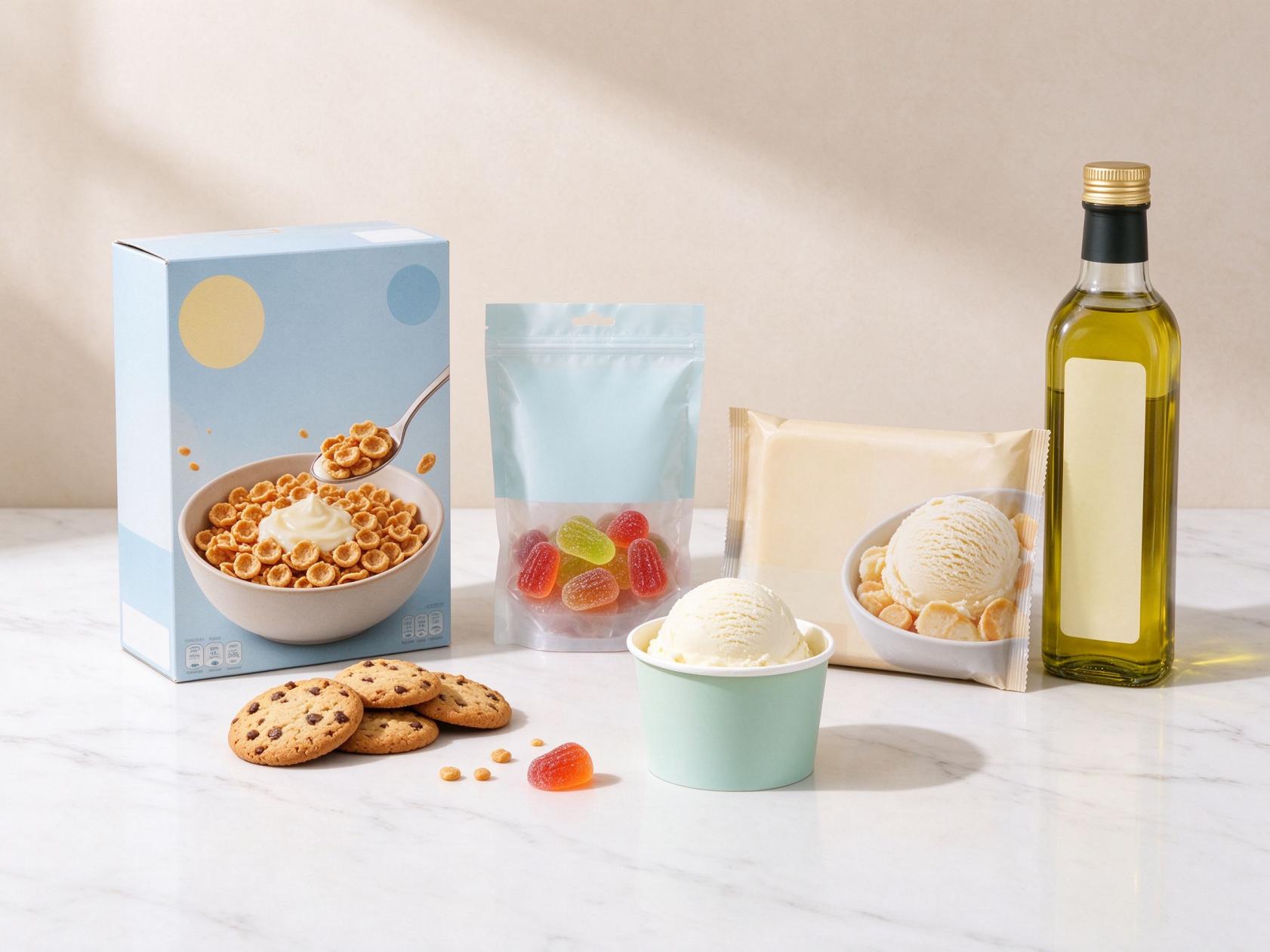
Figure 4: Everyday packaged foods that rely on antioxidant preservation
V. What Food Manufacturers Should Do Now
1. Map your BHA footprint. Identify the food categories, use levels, and food-contact applications in your portfolio that fall within the RFI's data request.
2. Participate in the data call. Submit aggregated use and exposure data — individually or through trade groups — so that FDA refines its exposure estimates with real market information rather than maximizing assumptions.
3. Monitor the docket. Track Docket No. FDA-2026-N-0302 and FDA's "List of Select Chemicals in the Food Supply Under FDA Review" for upcoming milestones and any proposed rulemaking.
4. Evaluate alternatives now. Tocopherols (vitamin E), rosemary extract, and ascorbyl palmitate are widely used oil-soluble antioxidant options. Confirm that any replacement is itself authorized for the intended use under U.S. food regulations before reformulating — and remember that BHT, BHA's traditional partner, is itself under FDA review.
5. Demand supplier documentation. Require COA, batch traceability, heavy metal and microbial test reports, and stability data from raw material suppliers, so your compliance file is ready for any label or registration question.
6. Plan for state-level divergence. With state bans effective from 2028, review formulation and product registration plans for each market you serve.
Figure 5: Regulatory review is reshaping the compliance landscape for food ingredients
Conclusion
BHA remains legal at the federal level as of September 2026, but the direction of travel is clear: the FDA's first formal re-assessment in decades, a pending prohibition petition, state-level bans, and retailer exclusions all point to tighter scrutiny ahead. Manufacturers that map their exposure today, participate in the data call, and prepare reformulation scenarios will be best positioned regardless of how the assessment concludes.
Leafchem is a professional manufacturer and supplier of food additives, cosmetic ingredients, and fine chemicals. For high-purity BHA (CAS 25013-16-5 / 121-00-6) with full COA, batch traceability, and regulatory documentation support, contact our team today.










 IPv6 network supported